ServicesWhole-Home Filtration
Whole-Home Filtration for Lockhart Homes
A single filter on the main water line treats what reaches every tap, shower and appliance in the house. We start with a test, explain plainly what the filter will and won't fix, and quote each item over the phone.
What a whole-home filter does
Tap water from the city is treated to stay safe all the way through the pipes, and that treatment is chlorine or chloramine. It's the smell that hits you in a hot shower and the taste in a glass from the faucet. A filter on the main line removes most of it before the water splits off, so your kitchen, bathrooms, washer and ice maker all get the same cleaner water.
Now the limits. Carbon fixes taste, odor and fine sediment. It won't soften anything. White crust on faucets or spots on dishes come from hardness, and that's a job for a water softener or a salt-free water conditioner. Lots of houses need a filter and one of those, and we'll say so if yours does.
What's included in the job
- Testing comes first
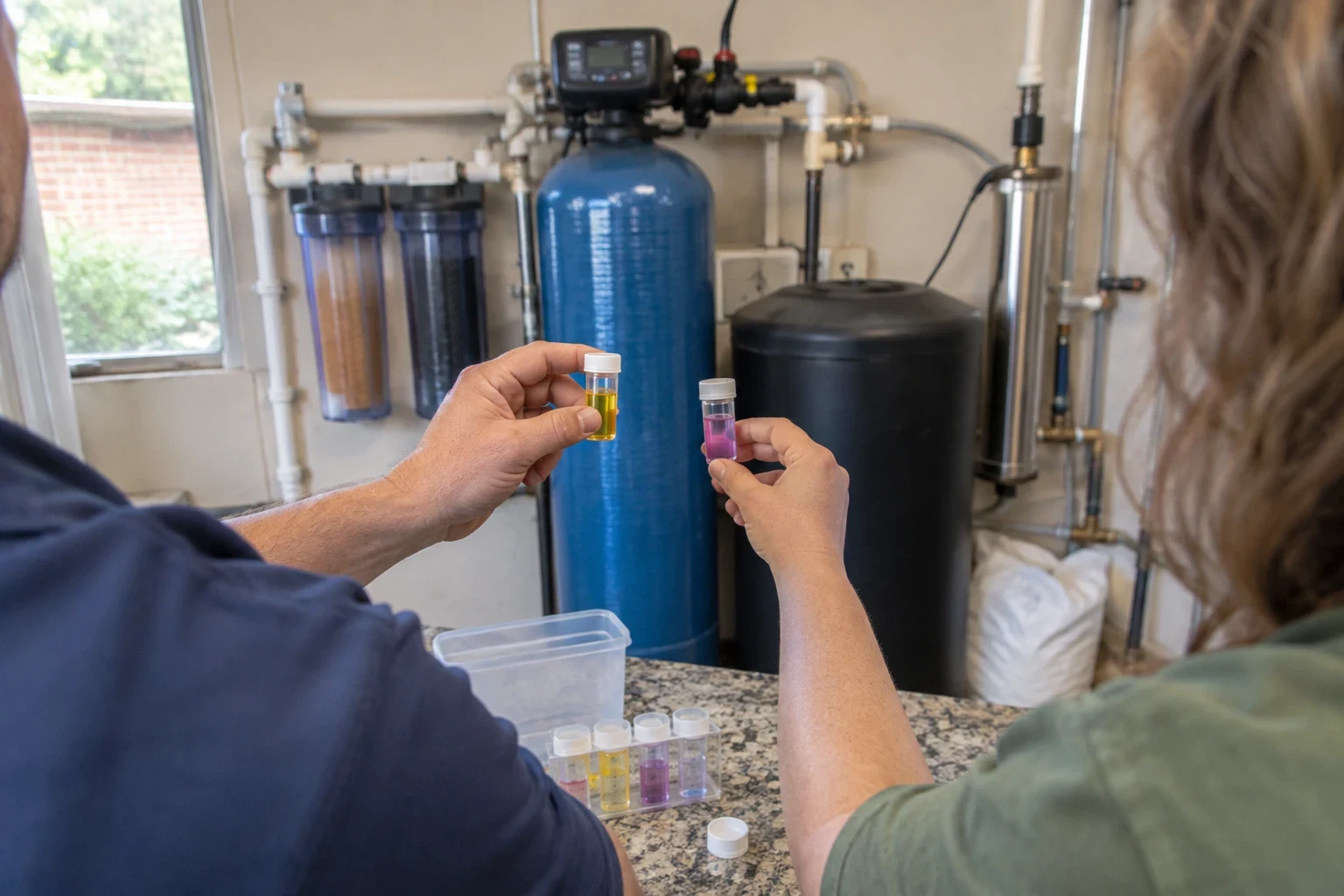
- We check your tap water for chlorine, hardness, iron and sediment before we suggest any equipment. The results decide what we recommend.
- Sediment prefilter
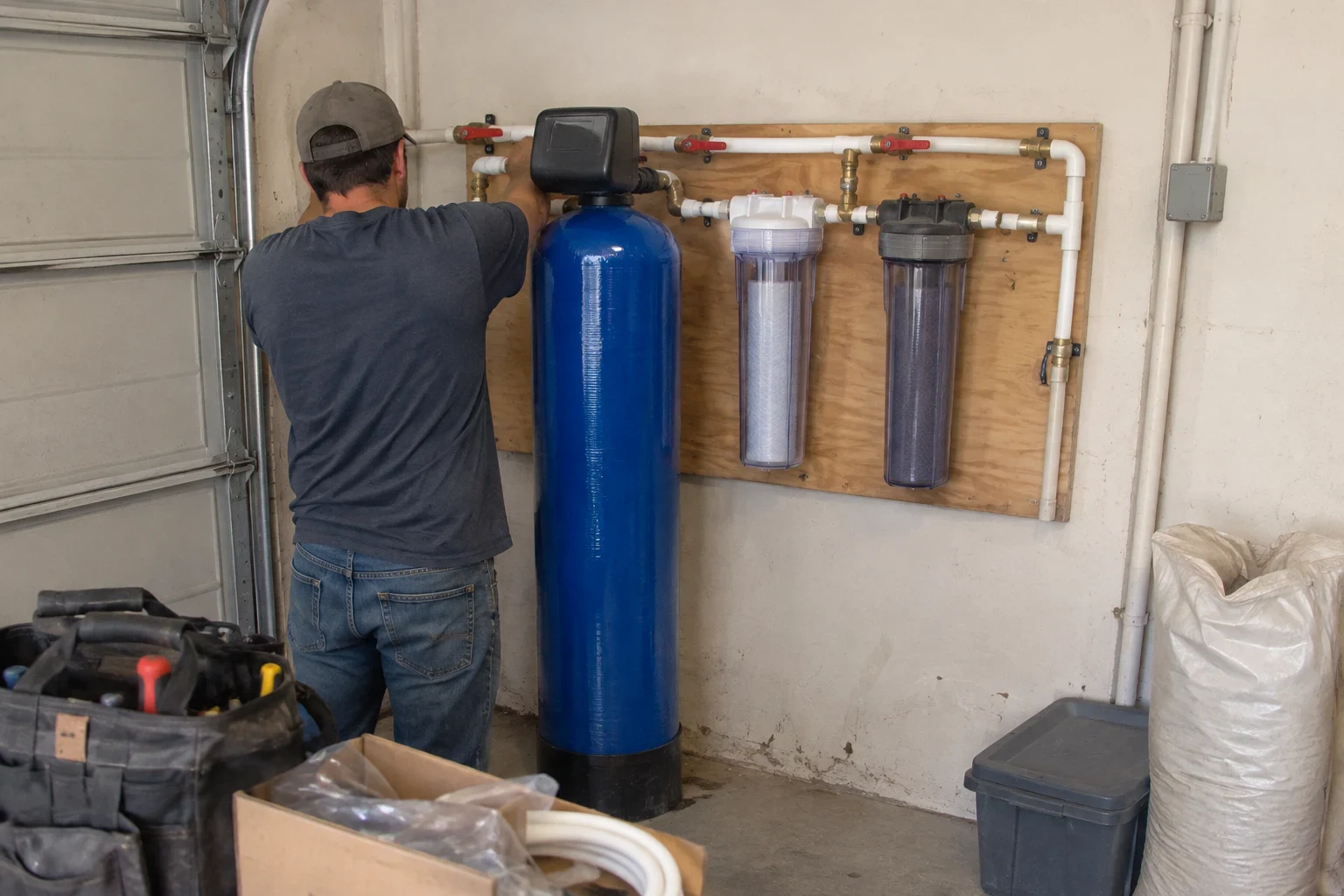
- A cartridge mounted ahead of the carbon tank catches sand, grit and bits of old scale from the pipes. Stopping that debris early means the carbon stays clear and works longer.
- Carbon tank matched to your house
- We size the tank by your number of bathrooms and how much water tends to run at once. If the test points to chloramine, we use catalytic carbon, since standard carbon struggles to remove it.
- Bypass valve
- Every system gets a bypass. One turn sends water around the filter, so your taps keep working during a cartridge change.
- Free installation
- You don't pay for installation. That covers cutting into the main line, mounting the system and testing it after it's up and running.
- Cleanup and a quick lesson
- Packaging and spare fittings leave with us, and the work area is swept. Before we head out, we walk you through the bypass and a cartridge swap.
Signs your home could use one
Showers smell like chlorine
Heat drives chlorine out of the water as steam, so most people notice it first in the bathroom. An under-sink unit can't help there. Only a filter on the main line reaches the shower.
Pitcher filters are a constant chore
A pitcher or faucet filter treats one spot and nothing else. If you're always buying cartridges and still don't like the water at other taps, filtering the whole house is the simpler fix.
Aerators keep clogging
Grit in faucet screens and showerheads is a sign sediment is getting through. A prefilter stops it before it gets to your fixtures.
Coffee and ice taste wrong
Fridge filters are small and often overdue for a change. With the main line filtered, that little cartridge has much less work to do.
You don't know what's in the water
Then a test should come before any purchase. Our Water Testing & Analysis page covers what we look for.
What moves the price
Since installation is free, most of the cost is the equipment itself. Price comes down to how much water your home uses, what's in it and how easy the main line is to reach. We give you the number by phone after the test, with no add-ons later.
Size of your home
More bathrooms means more water flowing at once. A bigger tank keeps the pressure up when the shower and dishwasher run together.
Chlorine or chloramine
Chloramine needs catalytic carbon, which costs more than standard carbon. The water test tells us which one you have.
Main line location and pipe type
An easy-to-reach line in the garage needs fewer parts than one that has to be rerouted. Copper, PEX and older pipe all take different fittings.
Extra treatment
If the test shows hardness or iron, you may want a softener or an iron filter too. We'll quote those separately so you can decide.
Ongoing upkeep
Sediment cartridges get swapped a few times a year and carbon media gets replaced every few years. We'll tell you what that looks like for your water up front.
How the work goes
- 1
Free water test and quote
We test your water and find where the main line enters the house. You hear what we found and get a quote broken out item by item.
- 2
Choose where it goes
The usual spots are the garage or outside near the main shutoff. The system needs level ground, space to swap cartridges and a drain close by if it backwashes.
- 3
The install
With the water off, we open up the main line and plumb in the bypass, prefilter and tank. Expect a few hours without water, and we'll walk you through the timing before any pipe gets cut.
- 4
Flush, check and hand off
The new media gets flushed until the water runs clear. We check pressure at several faucets, retest the water and show you the numbers from before and after, then clean up.
Common questions about whole-home filters
Will a filter on the main line lower my water pressure?
It should not. A pressure drop after an install almost always means the tank is undersized for the house. We pick the tank size from your bathrooms and fixtures, and before we leave we run several faucets together to confirm the flow.
Is reverse osmosis worth adding for drinking water?
It comes down to your goal. The carbon filter on the main line takes care of taste and odor everywhere in the house. An under-sink reverse osmosis system adds another layer, pulling dissolved minerals and trace contaminants out of the water you cook with and drink. Some households go with both, and many are happy with the whole-home filter on its own.
Will it get rid of spots on glasses and crust on fixtures?
No. Spots and crust come from calcium and magnesium, which pass right through carbon. When the test shows hard water, the fix is a softener or a salt-free conditioner.
How much upkeep is involved?
Very little. A few times a year you swap the sediment cartridge, a few minutes of work after you turn the bypass. The carbon media holds up for years, depending on your water and your household's use.
Do you take jobs in Kyle, Buda and other towns nearby?
We do. Beyond Lockhart, we work in Luling, San Marcos, Kyle, Buda, Cedar Creek and Redwood. Every town gets the same free water test, the same phone quote and the same install process.
Find out what your water needs
We'll test your water for free and tell you plainly whether a whole-home filter makes sense for your home. If it does, you get a clear quote on the same call.