ServicesUV Water Purification
UV Water Purification in Lockhart
A UV system disinfects the water coming into your home with light instead of chemicals. It neutralizes 99.9% of bacteria with no chemicals, and your water tastes the same as before. We test first, tell you straight if UV fits, then size it to your flow.
What UV Can and Can't Do
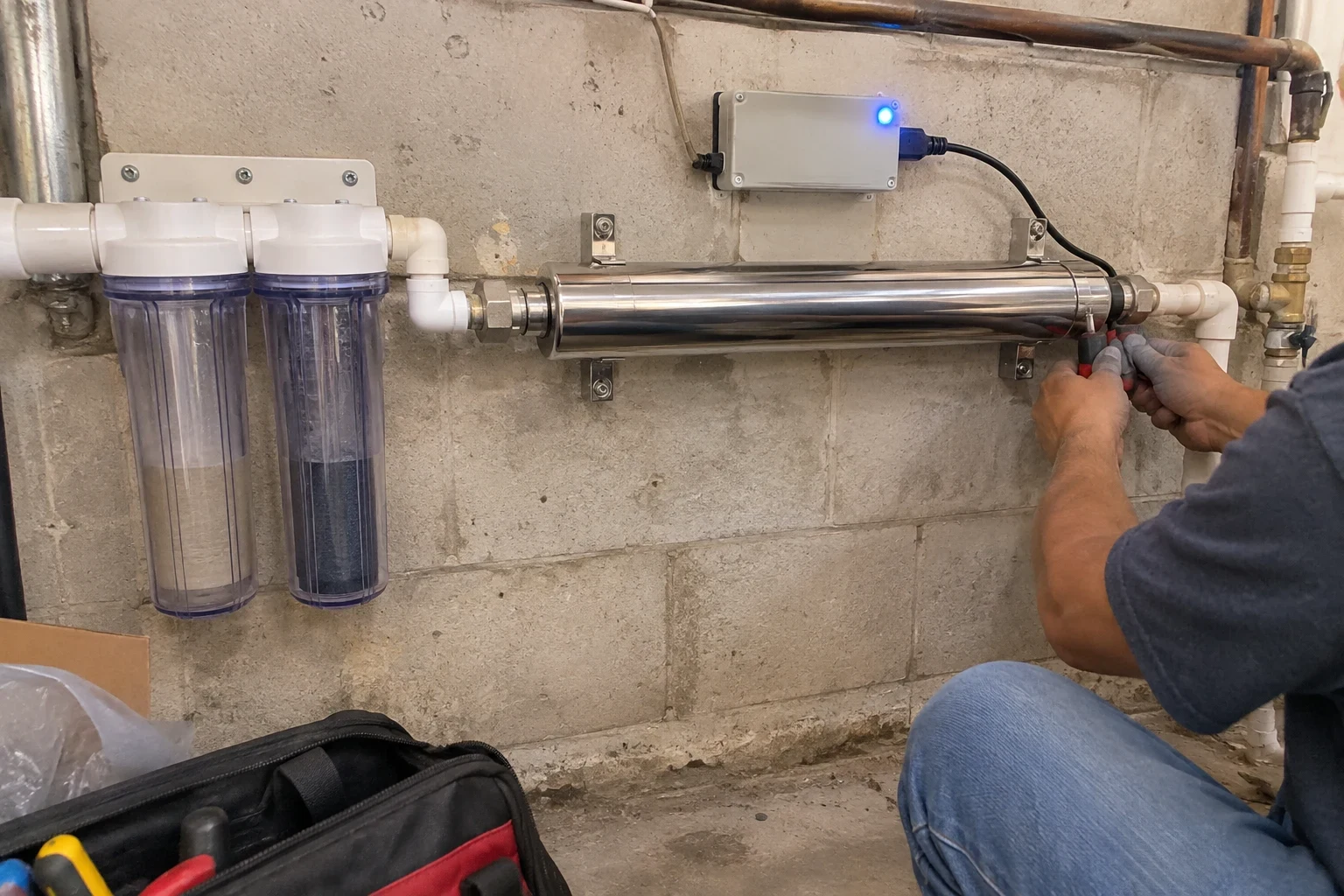
The system is a metal housing mounted on your main water line, with a UV lamp held inside a clear quartz tube. Water flows past the lamp. UV-C light neutralizes 99.9% of bacteria, so they can't multiply or make anyone sick.
Here is what it won't do. UV leaves lead, chlorine, iron, hardness, odor and chemicals untouched. It only disinfects. For bad taste, stains or scale, you need whole-home filtration, iron and sulfur removal or a softener, and we will steer you to the right one.
UV is worth having when germs have a way into your supply: a private well, water that is stored or hauled, or a household that wants a backup after boil-water notices. Most Lockhart homes on treated city water are already covered by chlorine, so we test before recommending anything.
What a UV Install Includes
- Water test before we quote
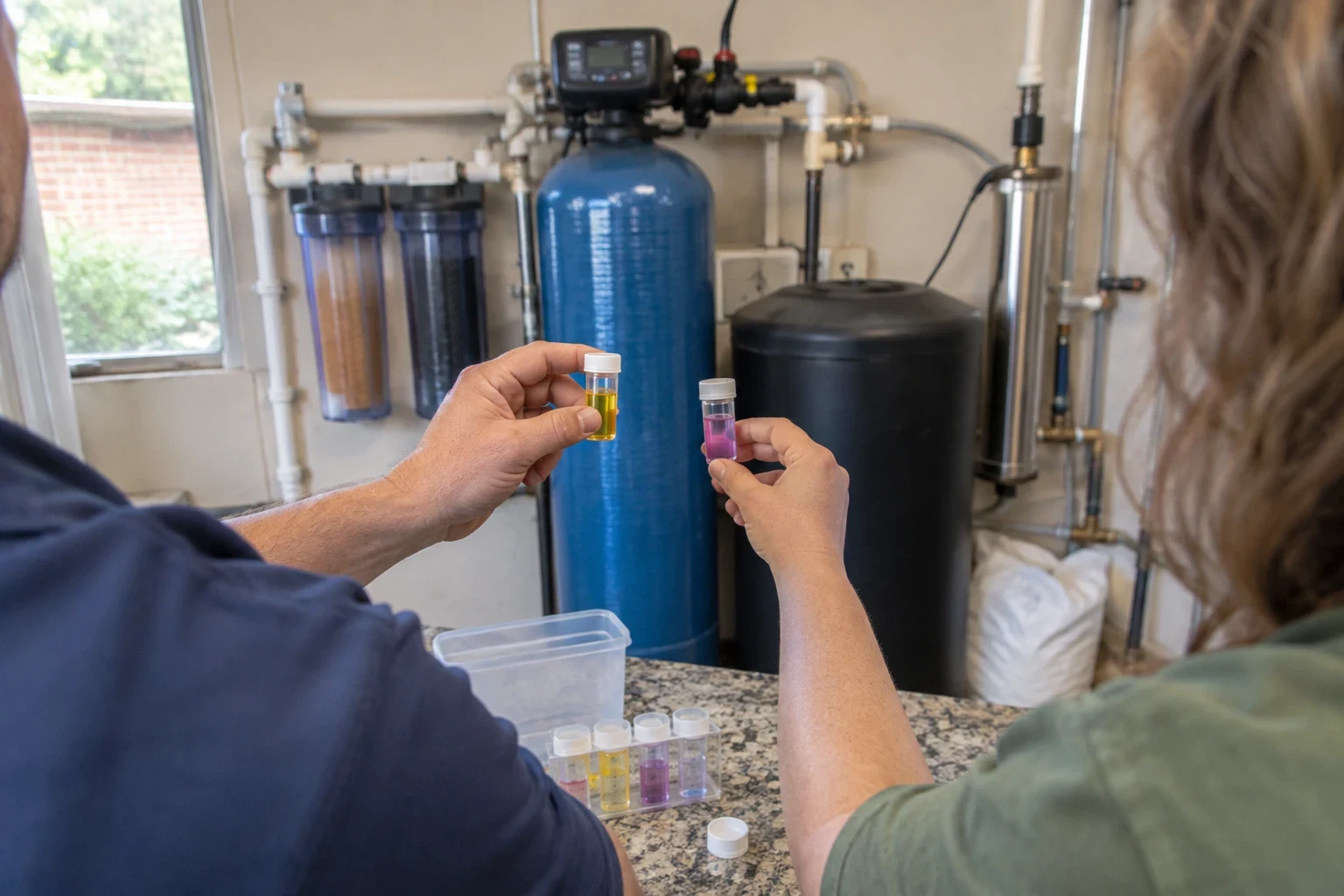
- We test for bacteria, iron, manganese, hardness and turbidity. The results show whether UV will work and what needs to go ahead of it.
- Correctly sized chamber
- The unit is sized to the peak gallons per minute your home draws. A lamp that is too small lets water speed by without enough exposure.
- Sediment prefilter
- A 5-micron filter sits before the lamp. Dirt particles can shield germs, and sediment builds up on the sleeve.
- Point-of-entry install
- We mount the system on the main line so treated water reaches every tap. It needs a standard outlet close by, and we choose the location with you.
- Plumbing sanitized after install
- UV treats only the water past the lamp. We flush and disinfect the lines after it so bacteria already in the pipes do not hang around.
- Walkthrough on upkeep
- You learn how to read the lamp indicator, change the lamp each year and clean the sleeve. Free installation covers the equipment we install.
When UV Deserves a Look
A positive bacteria test
Coliform or E. coli showing up on a lab report is the strongest case for it. UV deals with it daily and puts nothing into the water.
You're on a private well
After a hard rain, surface water can seep into a well, more so a shallow one or one with a worn cap. UV alongside well water filtration takes care of that risk.
Stomach trouble with no other cause
Upset stomachs that keep coming back in one household can trace to the water. Test it rather than guess.
You don't want chlorine in the water
Some households want water disinfected with no chemicals and no added taste. UV handles that, provided the water entering it is clear.
Boil notices make you nervous
If an earlier notice had you hauling bottled water, UV can serve as a backup layer. It does nothing for a pressure loss, but it treats the water coming in.
How the Job Goes
- 1
Test and straight answer
First we test your water and walk you through the numbers. If you don't need UV, you'll hear that from us, along with what will actually help.
- 2
Plan the spot
The unit belongs on the main line, after any softener or iron filter and ahead of the water heater. We look for a nearby outlet and enough clearance to pull the lamp out later.
- 3
Install and power up
With the main valve closed, we plumb in the prefilter and the UV unit, plus a bypass loop for future service. Expect the work to take a few hours on most homes.
- 4
Sanitize and flush
We disinfect the pipes downstream of the unit, open every faucet to flush them, and clean up our work area. Before we leave, you'll see how the controls work and what the alarm means, if your model has one.
What Moves the Price
UV equipment is fairly simple, so the price swings mostly on what your water needs before it reaches the lamp. A clean test means a short, simple job. Iron or hardness means more equipment up front. We give you the full number by phone, broken out line by line.
- Flow rate
- A bigger home with more bathrooms needs a higher gallons-per-minute rating and a larger chamber.
- Pretreatment
- Iron, manganese and hardness coat the quartz sleeve and block the light. If your test shows them, you need filtration or softening ahead of the UV.
- Monitoring features
- Basic units have a lamp timer. Others add a sensor that reads light strength and sounds an alarm when it drops.
- Install location
- Tight spaces, no nearby outlet or hard-to-reach pipes add time. An open garage wall is the easy case.
- Ongoing parts
- Plan on a new lamp about once a year and prefilter cartridges a few times a year. We tell you those costs before you buy.
UV Purification Questions
Something not covered here? (512) 710-1976
Do I need UV if I'm on city water?
Most of the time, no. City water is treated with chlorine, and that already handles disinfection. UV on city water only makes sense if you want a backup or a test turns up a problem inside your own plumbing.
Will UV make my water taste better?
It won't. UV has no effect on taste, odor or chlorine. If taste is the issue, whole-home filtration or a reverse osmosis system for drinking water is the better fit.
How often does the lamp need changing?
Plan on a new lamp every year or so. An old lamp can keep shining long after its germ-killing output has faded too low to do the job. A lit lamp is not proof it's working, so go by the calendar or the unit's timer.
What happens if the power goes out?
No power means no light, so any water moving through during the outage goes untreated. Once power is back, give the lamp time to warm up and run your taps a few minutes before you drink from them.
Can UV handle iron or sulfur smell?
No. Iron is actually a problem for UV because it fouls the sleeve and blocks the light. We take out iron and sulfur first with iron and sulfur removal, and the UV goes in after that.
Find Out If UV Fits Your Water
We'll test your water for free and tell you plainly if UV is needed or if something else is the real fix. Then you get a clear quote by phone.