How Can I Remove Viruses From Water in My Lockhart Home?
Most filters people already own do nothing about viruses, so here is what does work and when you actually need it.
How can I remove viruses from water?
To remove viruses from water, you need to kill them or block them. Boiling works short term. A UV light system kills viruses as water flows through your home. A reverse osmosis system blocks most of them at one faucet. A standard carbon or sediment filter will not do the job. For a free water test, the number is (512) 710-1976.
Why a regular filter won't stop viruses
Viruses are tiny. Most are far smaller than bacteria, and far smaller than the openings in a sediment cartridge or a carbon block. Water carries them right through.
Carbon is good at what it does. It takes out chlorine taste and smell and a range of chemicals. But it is not built to catch or kill germs, and a carbon filter that sits unused can even grow bacteria inside it. So if your plan is a pitcher filter or a fridge filter, it is not a virus plan.
The options that actually work
There are four real ways to deal with viruses in household water. They work in different ways and fit different situations.
- Boiling: a full rolling boil for one minute kills viruses. Fine for a boil notice, not for every day.
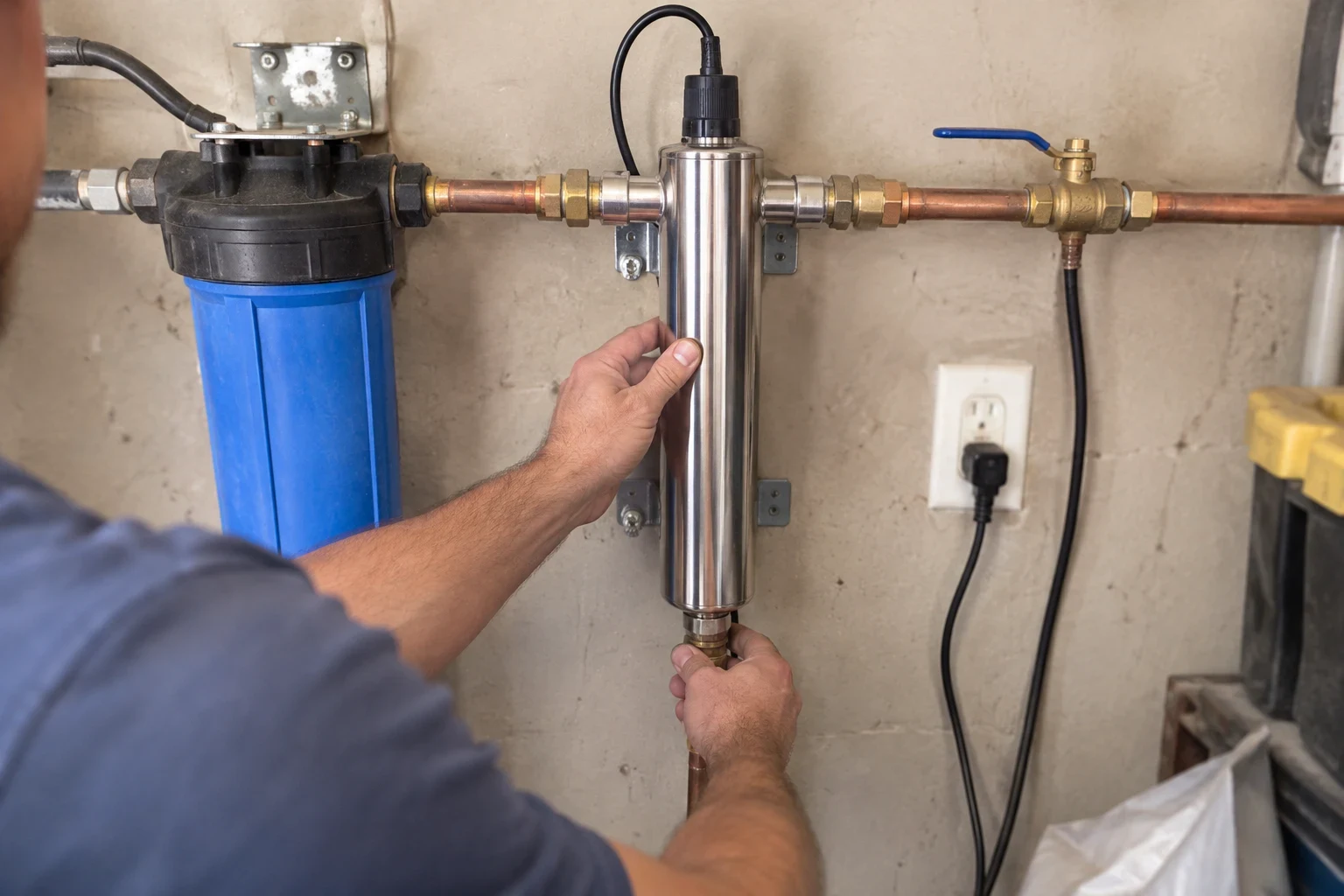
- UV light: water passes a lamp inside a steel chamber, and the light scrambles the virus so it can't infect you. Nothing is added to the water.
- Reverse osmosis: a very tight membrane blocks most viruses. It usually serves one kitchen faucet, not the whole house.
- Chlorine: this is what the city uses to disinfect. It works, but most homeowners don't want to add it at the tap.
How UV and whole-home filtration work together
UV is the main tool for treating every tap in your home. The catch is that UV light has to reach every drop. Cloudy water, sediment, iron or scale on the glass sleeve can shade a virus from the light and let it pass.
That is why we put a whole-home filter ahead of the UV unit. The filter catches grit and takes out chlorine taste. The UV lamp then sees clean, clear water and does its job. One setup covers showers, the kitchen and the laundry.
Upkeep is simple. The UV lamp gets replaced about once a year even if it still glows, because its output fades. The quartz sleeve gets wiped clean. The filter ahead of it gets changed on schedule. Skip those and the system is just a light in a pipe.
Do you need virus treatment on city water
Usually not every day. City water in Lockhart is disinfected before it reaches your meter, and that is the main protection against viruses. We won't tell you otherwise to sell a system.
Where it changes is when something goes wrong in the line. A main break, a loss of pressure or a hard freeze can let contamination in, and that's when a boil notice goes out. Some homeowners want a backup that keeps working during those days. Others have someone at home with a weak immune system and want extra protection all the time. Both are good reasons for UV.
If your only complaint is taste or smell, you likely need a carbon filter, not UV. A test tells us which it is.
What sets the cost of a UV and filter setup
We don't quote numbers before we see your home, because a few things move the price. A water test and a look at your plumbing answer most of them. Installation is free, so the quote covers the equipment.
- Your flow rate: bigger homes with more bathrooms need a larger UV chamber.
- Water quality: hardness or iron may call for extra pretreatment so the sleeve stays clear.
- Where the line comes in: garage, closet or outside wall changes the work.
- Power: UV needs an outlet close to the unit.
- Whether you add reverse osmosis at the kitchen sink too.
More questions about viruses in water
Does a water softener remove viruses?
No. A softener swaps hardness minerals and does nothing to germs. If you have a softener, it can sit ahead of a UV unit to help keep the sleeve clean.
Can a home water test check for viruses?
Labs rarely test for viruses directly at home. They test for coliform bacteria, which signals that germs could be getting in. A test also shows hardness and iron, which tells us how to set up UV correctly.
Should I still boil water during a boil notice if I have UV?
Follow the notice. A UV system that is kept up does kill viruses, but the notice is the official word, and boiling for a few days costs you nothing.
Does UV change how my water tastes?
No. UV adds nothing and takes nothing out. Any taste change comes from the filter ahead of it, which usually means less chlorine taste.
Find out what your water actually needs
Call and we'll set up a free water test, look at where your line comes in and give you a straight quote. If UV isn't needed, we'll say so.